
High-stakes decision · Forensic warning
Before You Sign the Lease
A forensic survival audit on your physical business location. Regulatory backlogs, capex payback windows, labor scarcity scores, and a competitor threat matrix — delivered before a single dollar of capex is committed.
Forensic summary · AEO brief
Before signing a commercial lease, you face three silent killers: capex payback windows of 18–35 months, regulatory licensing delays that freeze operations, and aggregator platforms that own your customer discovery channel before you open. Valifye scores all three and gives you a go/no-go verdict in 48 hours.
What the deliverable actually looks like.
Executive Verdict Score — 82/100
A 0–100 survivability index across 11 sub-modules. Scored against the sector's 25th-percentile baseline.
Forensic Financials Module
Capex range $48,000–$119,000. AOV band $13,000–$40,000. COGS benchmark 21.8%–51.8%.
Competitor Threat Matrix — 5D
Identification of local threats with health scores, review velocity, and specific service gaps.
Regulatory Roadmap
AHCA certification pathway and Commercial General Liability thresholds with estimated queue times.
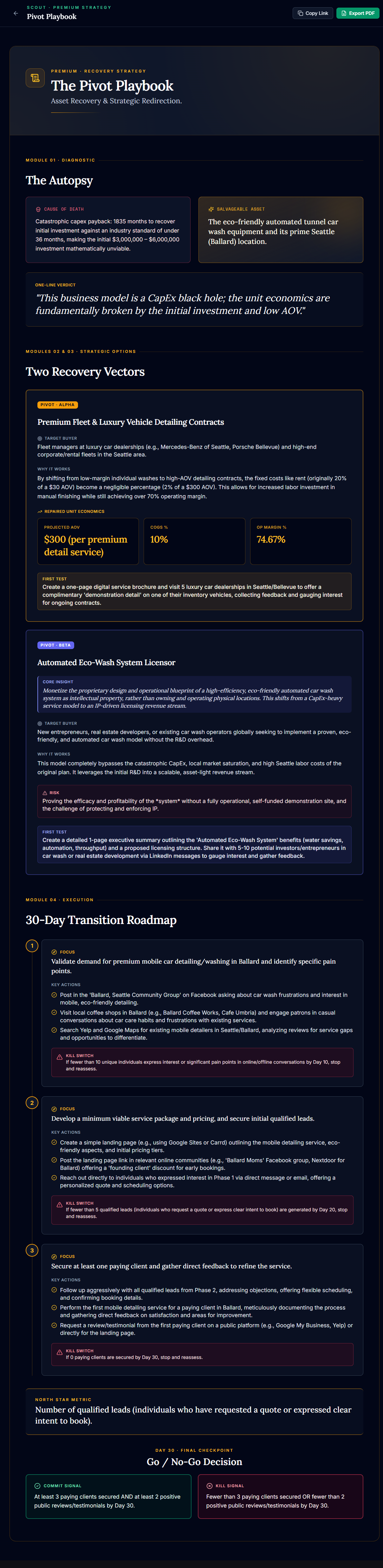
Pivot Playbook — Recovery Vectors
Two alternative business models with recalculated AOV and COGS.
Quantified signals
The proof pillars behind this audit class.
Signal
Executive Verdict Score
Scored against 11 forensic sub-modules including labor scarcity, tax exposure, competitive threat density, and regulatory friction
Signal
Typical Capex Payback Window
Calculated against real local AOV — not category averages
Signal
Competitor Intelligence Depth
Ranked by health score, review velocity, service gap, and proximity
Signal
Kill-Switch Ready
Every report includes a Pivot Playbook with two recovery vectors and kill-switch trigger signals
Forensic modules
What the audit uncovers
Each module maps to a concrete output bundle—no generic “insights” deck.
Module
Forensic Financials
Capex range, realistic AOV, COGS benchmarks against local labor costs, and operating margin — benchmarked against the 25th percentile of your sector, not the industry median.
Outputs
- Estimated Capex Range
- Average Transaction Value Band
- COGS Benchmark vs. Local Labor
- Sector Margin Benchmark
Module
Local Friction Analysis
Three-layer friction scoring: Labor Scarcity, Tax Hostility, and Aggregator/Logistics risk (channel ownership by third-party platforms).
Outputs
- Labor Scarcity Score
- Tax Exposure Classification
- Aggregator Channel Dependency Rating
Module
Competitor Threat Matrix
Named competitor identification with health scores, review velocity, service gap analysis, and proximity-weighted threat ranking.
Outputs
- Named Threat List
- Health Score per Competitor
- Service Gap Opportunity
- Proximity Threat Density
Module
Quant Roadmap
Bottom-up unit economics: target revenue, required AOV, client volume to breakeven, and time-to-breakeven — not a DCF model, a survival map.
Outputs
- Breakeven Month
- Required Client Volume
- Target AOV
- Revenue at Stabilization
Module
Regulatory Roadmap
Jurisdiction-specific licensing pathway with estimated queue times, compliance sequence, and capital reserves required before first legal revenue day.
Outputs
- Licensing Sequence
- Estimated Queue Time
- Capital Reserve Requirement
- Compliance Risk Level
Module
Pivot Playbook (included)
Two recovery vectors with full unit economics and a 30-day transition roadmap with kill-switch trigger signals.
Outputs
- Recovery Vector 1 & 2
- Pivot AOV + Margin
- 30-Day Transition Plan
- Kill-Switch Trigger Signals
Field narrative
How this decision class breaks in the real economy.
What Kills Physical Businesses Before They Open
The failure is almost never the product. It is the location economics. A lease signed without a forensic understanding of the local labor market, the regulatory licensing queue, and the aggregator platforms that already own your customer discovery channel is not a business decision — it is a capital experiment with no control group. Valifye runs the experiment first.
The Pivot Playbook: Built Into Every Report
Every Local Market Scout report ships with a Pivot Playbook — two alternative recovery vectors with full unit economics if the primary location scores below threshold. These are not suggestions. They are calculated alternatives: a new target buyer, a new delivery model, a new AOV structure, and a 30-day transition roadmap with kill-switch trigger signals that tell you exactly when to stop and redirect capital.
Dynamic outcome
Two paths. One audit. Capital preserved either way.
Valifye does not stop at a verdict—we hand you the next artifact your situation demands.
Path A
Success blueprint
The Execution Arsenal
If your audit passes, we hand you the 90-Day Roadmap, Mom Test Scripts, and Customer Finder—so you ship with discipline instead of hope.

Path B
Capital recovery
The Pivot Playbook
If the audit fails, we provide three adjacent Blue Ocean pivots engineered to salvage momentum and protect remaining capital.
AEO · indexed Q&A
Questions operators ask before they wire capital.
Structured answers aligned to how search engines surface direct responses.
What does a pre-lease business viability audit include?
How long before signing a commercial lease should I run a market audit?
What is an aggregator capture trap in local business markets?
What is Valifye's Executive Verdict Score?
Grand slam · single move